
[ad_1]

A DarkGate malware campaign observed in mid-January 2024 leveraged a recently patched security flaw in Microsoft Windows as a zero-day using bogus software installers.
“During this campaign, users were lured using PDFs that contained Google DoubleClick Digital Marketing (DDM) open redirects that led unsuspecting victims to compromised sites hosting the Microsoft Windows SmartScreen bypass CVE-2024-21412 that led to malicious Microsoft (.MSI) installers,” Trend Micro said.
CVE-2024-21412 (CVSS score: 8.1) concerns an internet shortcut files security feature bypass vulnerability that permits an unauthenticated attacker to circumvent SmartScreen protections by tricking a victim into clicking on a specially crafted file.
It was fixed by Microsoft as part of its Patch Tuesday updates for February 2024, but not before it was weaponized by a threat actor called Water Hydra (aka DarkCasino) to deliver the DarkMe malware in attacks targeting financial institutions.
The latest findings from Trend Micro show that the vulnerability has come under broader exploitation than previously thought, with the DarkGate campaign leveraging it in conjunction with open redirects from Google Ads to proliferate the malware.

The sophisticated attack chain begins with victims clicking on a link embedded within a PDF attachment sent via a phishing email. The link deploys an open redirect from Google’s doubleclick[.]net domain to a compromised web server hosting a malicious .URL internet shortcut file that exploits CVE-2024-21412.
Specifically, the open redirects are designed to distribute fake Microsoft software installers (.MSI) masquerading as legitimate software, such as Apple iTunes, Notion, NVIDIA, which come fitted with a side-loaded DLL file that decrypted and infected users with DarkGate (version 6.1.7).
It’s worth noting that another now-fixed bypass flaw in Windows SmartScreen (CVE-2023-36025, CVSS score: 8.8) has been employed by threat actors to deliver DarkGate, Phemedrone Stealer, and Mispadu over the past few months.
The abuse of Google Ads technologies allows threat actors to increase the reach and scale of their attacks through different ad campaigns that are tailored for specific audiences.
“Using fake software installers, along with open redirects, is a potent combination and can lead to many infections,” security researchers Peter Girnus, Aliakbar Zahravi, and Simon Zuckerbraun said. “It is essential to remain vigilant and to instruct users not to trust any software installer that they receive outside of official channels.”
The development comes as the AhnLab Security Intelligence Center (ASEC) and eSentire revealed that counterfeit installers for Adobe Reader, Notion and Synaptics are being distributed via fake PDF files and seemingly legitimate websites to deploy information stealers like LummaC2 and the XRed backdoor.
It also follows the discovery of new stealer malware families like Planet Stealer, Rage Stealer (aka xStealer), and Tweaks (aka Tweaker), adding to the plethora of cyber threats that are capable of harvesting sensitive information from compromised hosts.
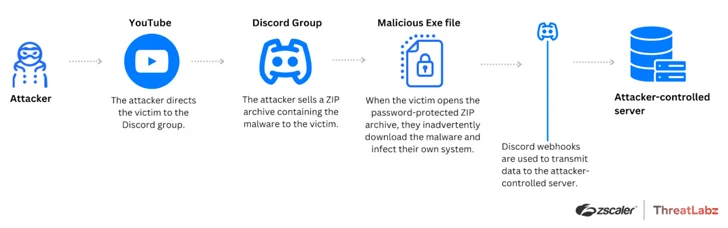
“Attackers are exploiting popular platforms, like YouTube and Discord, to distribute Tweaks to Roblox users, capitalizing on the ability of legitimate platforms to evade detection by web filter block lists that typically block known malicious servers,” Zscaler ThreatLabz said.
“Attackers share malicious files disguised as Frames Per Second (FPS) optimization packages with users and, in turn, users infect their own systems with Tweaks malware.”

The PowerShell-based stealer is equipped to exfiltrate sensitive data, including user information, location, Wi-Fi profiles, passwords, Roblox IDs, and in-game currency details, to an attacker-controlled server via a Discord webhook.
Malvertising and social engineering campaigns have also been observed acting as an initial access vector to disseminate a wide range of stealer and remote access trojans like Agent Tesla, CyberGate RAT, Fenix botnet, Matanbuchus, NarniaRAT, Remcos RAT, Rhadamanthys, SapphireStealer, and zgRAT.
[ad_2]