

• Book Dewayne Hart
  • Dewaynehart@dewaynehart.com
  • (470) 409 8316
  • Speaker Bio
  • Home
  • About
  • Speaker
  • Books
  • Podcast
  • Contact
  • Blog
  • Home
  • About
  • Speaker
  • Books
  • Podcast
  • Contact
  • Blog
Facebook-f Linkedin-in Youtube X-twitter Globe
Order books

Hackers Exploit Google Tag Manager to Deploy Credit Card Skimmers on Magento Stores

Posted on February 10, 2025 by admin

[ad_1]

Feb 10, 2025Ravie LakshmananMalware / Payment Security

Threat actors have been observed leveraging Google Tag Manager (GTM) to deliver credit card skimmer malware targeting Magento-based e-commerce websites.

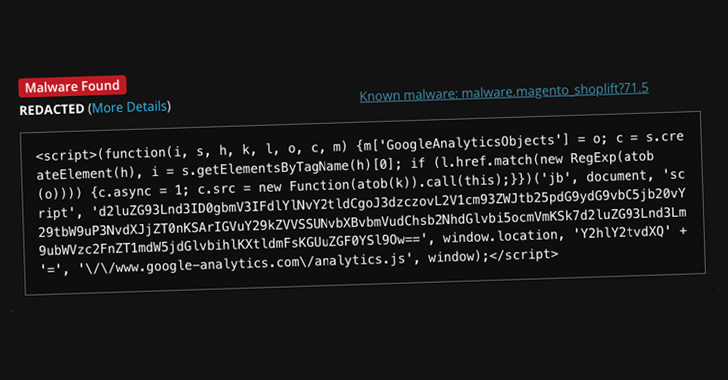
Website security company Sucuri said the code, while appearing to be a typical GTM and Google Analytics script used for website analytics and advertising purposes, contains an obfuscated backdoor capable of providing attackers with persistent access.

As of writing, as many as three sites have been found to be infected with the GTM identifier (GTM-MLHK2N68) in question, down from six reported by Sucuri. GTM identifier refers to a container that includes the various tracking codes (e.g., Google Analytics, Facebook Pixel) and rules to be triggered when certain conditions are met.

Further analysis has revealed that the malware is being loaded from the Magento database table “cms_block.content,” with the GTM tag containing an encoded JavaScript payload that acts as a credit card skimmer.

Cybersecurity

“This script was designed to collect sensitive data entered by users during the checkout process and send it to a remote server controlled by the attackers,” security researcher Puja Srivastava said.

Upon execution, the malware is designed to pilfer credit card information from the checkout pages and send it to an external server.

This is not the first time GTM has been abused for malicious purposes. In April 2018, Sucuri revealed that the tool was being leveraged for malvertising purposes.

The development comes weeks after the company detailed another WordPress campaign that likely employed vulnerabilities in plugins or compromised admin accounts to install malware that redirected site visitors to malicious URLs.

Found this article interesting? Follow us on Twitter  and LinkedIn to read more exclusive content we post.


[ad_2]

Recent Posts

  • Secure to Scale: 7 Executive Strategies to Align Cybersecurity With Business Growth
  • No Blind Spots: A Veteran’s Blueprint to Protect Critical Infrastructure
  • Cybersecurity as a Growth Lever: A Board-Ready Playbook for CIOs and CTOs
  • From Reaction to Readiness: Building a Cybersecurity Mindset for Proactive Defense
  • Cybersecurity Leadership in 2026: Executive Decisions that Drive Resilience and Growth

Recent Comments

No comments to show.

Archives

  • March 2026
  • February 2026
  • July 2025
  • May 2025
  • April 2025
  • March 2025
  • February 2025
  • January 2025
  • December 2024
  • November 2024
  • October 2024
  • September 2024
  • August 2024
  • July 2024
  • June 2024
  • May 2024
  • April 2024
  • March 2024
  • February 2024
  • January 2024
  • December 2023
  • November 2023
  • October 2023

Categories

  • Cyber News
  • Uncategorized

Book Dewayne Hart for your next event

  • Dewaynehart@dewaynehart.com
  • (470) 409 8316
Facebook-f Linkedin-in Youtube X-twitter Globe
© 2025 Dewayne Hart | Cybersecurity Leadership & Innovation
no_deposit_bonus