
[ad_1]
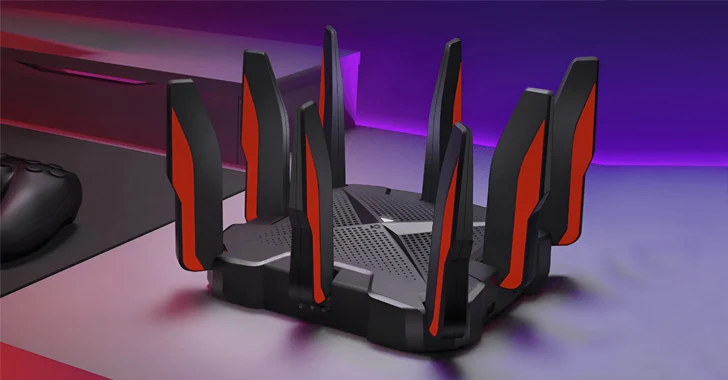
A maximum-severity security flaw has been disclosed in the TP-Link Archer C5400X gaming router that could lead to remote code execution on susceptible devices by sending specially crafted requests.
The vulnerability, tracked as CVE-2024-5035, carries a CVSS score of 10.0. It impacts all versions of the router firmware including and prior to 1_1.1.6. It has been patched in version 1_1.1.7 released on May 24, 2024.
“By successfully exploiting this flaw, remote unauthenticated attackers can gain arbitrary command execution on the device with elevated privileges,” German cybersecurity firm ONEKEY said in a report published Monday.

The issue is rooted in a binary related to radio frequency testing “rftest” that’s launched on startup and exposes a network listener on TCP ports 8888, 8889, and 8890, thus allowing a remote unauthenticated attacker to achieve code execution.
While the network service is designed to only accept commands that start with “wl” or “nvram get,” ONEKEY found that the restriction could be trivially bypassed by injecting a command after shell meta-characters like ; , & , or, | (e.g., “wl;id;”).

TP-Link’s implemented fix in version 1_1.1.7 Build 20240510 addresses the vulnerability by discarding any command containing these special characters.
“It seems the need to provide a wireless device configuration API at TP-Link had to be answered either fast or cheap, which ended up with them exposing a supposedly limited shell over the network that clients within the router could use as a way to configure wireless devices,” ONEKEY said.
The disclosure arrives weeks after security flaws were also revealed by the company in Delta Electronics DVW W02W2 industrial Ethernet routers (CVE-2024-3871) and Ligowave networking gear (CVE-2024-4999) that could allow remote attackers to gain remote command execution with elevated privileges.
It’s worth noting that these flaws remain unpatched due to the devices being no longer actively maintained, making it imperative that users take adequate steps to limit exposure of administration interfaces to reduce the potential for exploitation.
[ad_2]